I was planning this trip for quite some time, and contrary to the rest of the family I was looking forward to it more than to our normal summer holidays in Ibiza. I am still relatively new to boating. It was my first time driving a motorboat on a river. I was ready to cancel the trip in case of too much water, and I planned to rely on advice from locals in case of low water. And still it had many unknowns and uncertainties.
- How would foiling work on a river with current?
- How would the range be affected by the current?
- How would charging work?
- How bad would the traffic be on Europes busiest inland waterway?
- Would my trip plan hold up, or would we have to improvise?
- How would trailering the boat work?
- How would the family like it?
Preparations
Lately I realized that the boat would come up to foil with less weight than last year. Candela support told me the most likely cause was algae growth on the under body. So I had the boat cleaned and an anti-fouling paint applied shortly before we departed.
Internet videos suggested that AIS was very practical when leaving harbors. Sometimes you don’t have good overview of what is happening on the river until you leave the harbor. So I evaluated some options. Best would be to have it directly on the chart plotter. But that would require an installed radio and the accompanying license. Since AIS is not used on our home lake, and we won’t go so often to waters where it is used, I decided to go without. But maybe the radar will also be helpful?
When I made my car driving license, permission to drive with a trailer was gifted to me. Since I had little to no experience, I booked a driving instructor to train it voluntarily.
I also asked the guy who rented the trailer to me to show me how the boat is properly loaded on a slipping ramp. It took quite a bit longer than I anticipated. We also had to adjust the trailer to the boat.
Last but not least, my car doesn’t have enough towing capacity, so I borrowed a heavier car from a friend of my brother.
Day 1: Kehl to Rheinstätten
In the early morning we drove off from home with the massive trailer. As to my understanding, you couldn’t tow anything much bigger behind a car. Driving forward worked remarkably well, especially on the highway. And when I had to drive backwards, I just took my time, and tried as many times as was necessary. We reached Kehl near Strasbourg shortly after lunch. I was happy that somebody was present, who could push the trailer down the slipping ramp around the corner with a tractor.
Excited by the adventure ahead of us, we took the first short swim shortly after leaving Kehl. Not much later we entered the first lock. We were surprised to see so few boats. We were mostly on our own. People told me that the big ships have priority, and the smaller ones always have to wait. All the more we were pleasantly surprised that we had the lock for ourselves and they moved us down immediately.
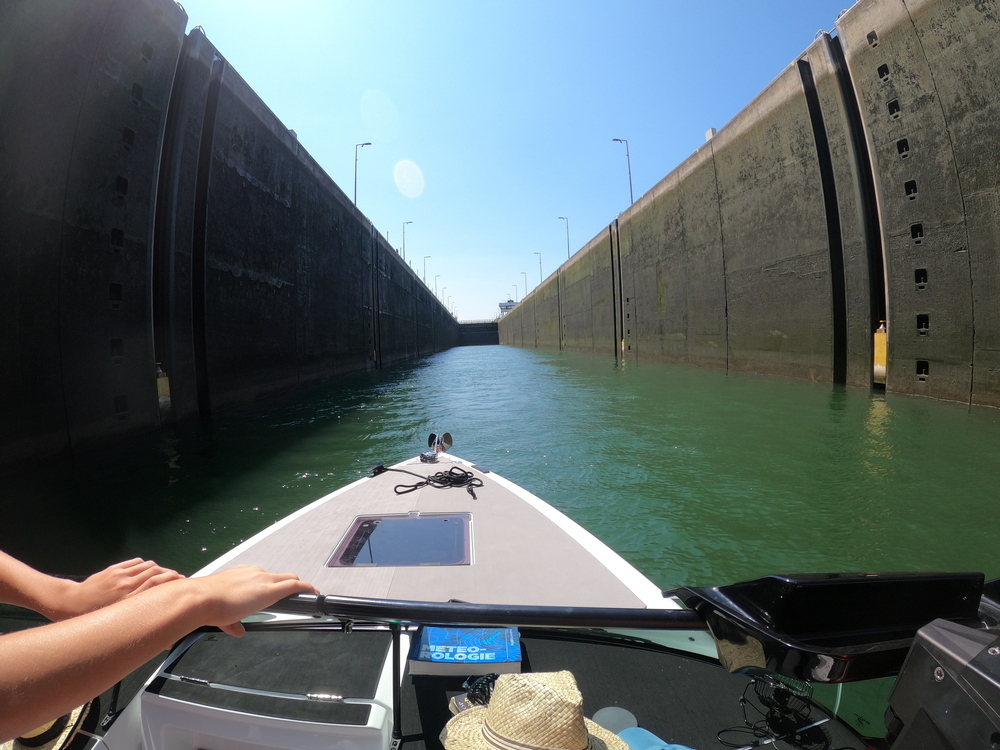
After the Iffetsheim lock, we entered what people call the “wild Rhine”. In the upper part, the water level is regulated by the locks and hydroelectric dams. There is barely any current and plenty enough depth. The lower part is free flowing. Just after the lock, we saw a harbor, and wanted to have dinner, ideally, while charging the boat. The water was so low, that we could barely navigate into the harbor. The people with slightly bigger boats told us that they are currently trapped in the harbor. It was a very nice area, but unfortunately, the restaurant was closed and no shop was nearby. So we continued.
In the free flowing part, the current was visible, and I assumed it would be the average 5 to 6 km/h that I found in the internet. Later I learned that in this part it is actually closer to 12km/h. Foiling downstream felt a bit awkward, but it worked well. The awkwardness was probably from the small swirls you could see everywhere in the water coming from the water flowing around obstacles, and since I was going too slow because of my wrong assumption about the speed of the current.
The initial plan was to spend the first night in Speyer, but as the battery went below 10%, I drove to the marina of “Yachtclub Oberrhein” in Rheinstätten shortly before Karlsruhe. That is quite a bit shorter than the 100km range I assumed for going downstream. I think the main factors are that the river has almost no current in the upper section, and we loaded the boat with 4 people plus lots of luggage. The two locks surely also cost some range.
Day 2: Heidelberg
The people in the marina were super friendly and helpful. They advised us to not go further downstream, because the water was so low, that boats could no longer enter or leave the harbors. In the river itself there was still enough water, but not entering a harbor means not charging the battery. So we visited nearby Heidelberg by train, and spent another night at the same harbor.
Part of the reason to stay longer was also that the battery was not charged fully in the morning. The boat charged with only 2.8 kW due to the voltage being slightly lower than 200V at the berth.
Day 3: Rheinstätten to Greffern
Right when we left the harbor and entered the current, I tried to get up on foils against the current. When it didn’t work the first time, I lowered the anchor and waited for the motor to cool down. I tried the same thing about four times before I gave up. Apparently the GPS speed does have an influence in the flight computer. The river was too narrow to get on foils downstream and do a 180. I wanted to stay upstream of the familiar harbor to always have the option to return there. So I motored upstream for a while with 7km/h ground speed, burning through the battery much quicker than if we cold foil. When I saw the small lake adjacent that we were told was so nice for swimming, we relaxed for a while in the calm water.
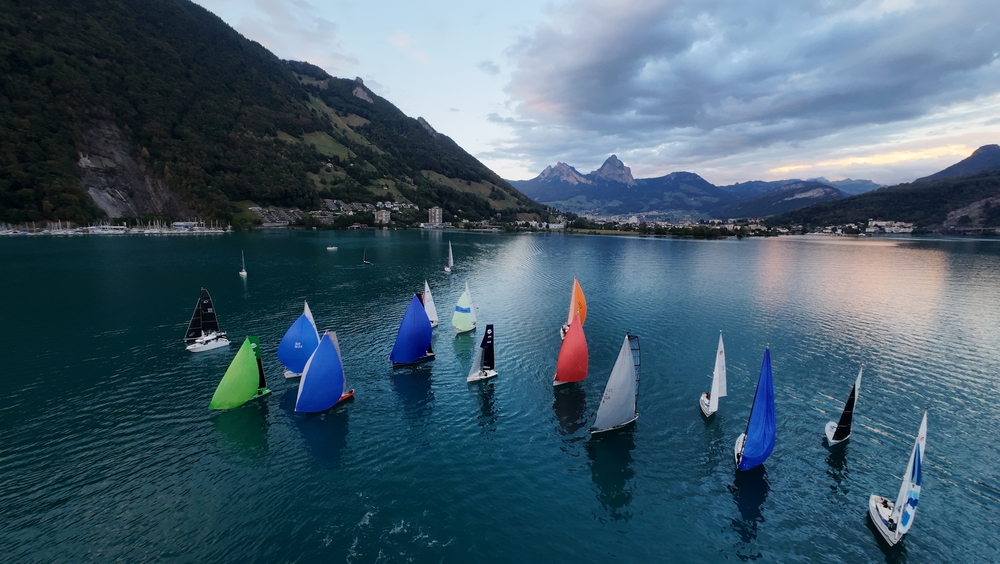
For our standards the water looked a bit dirty. But that’s because we are used to Lake Lucerne which is exceptionally clean and has low nutrition levels.
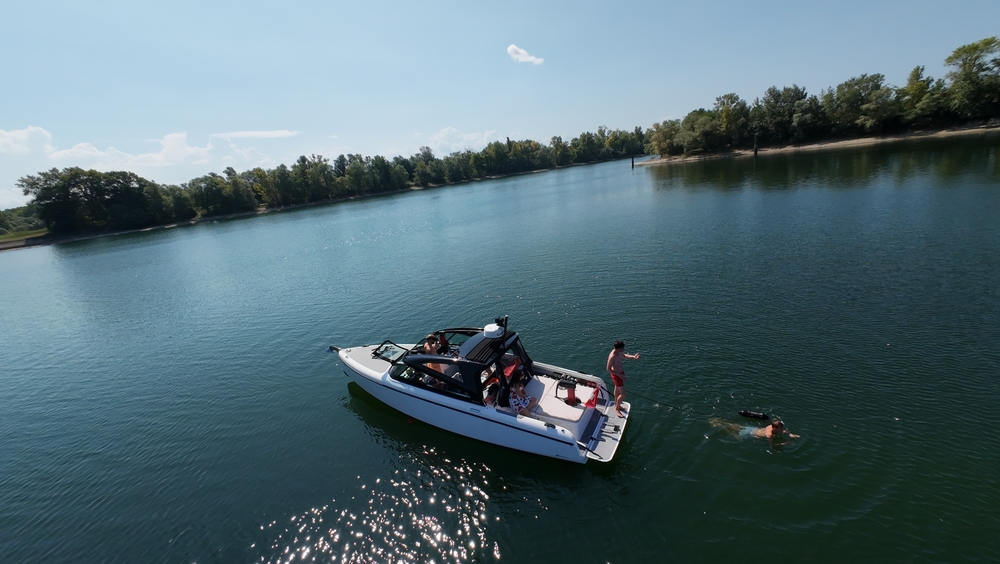
Then came the big moment. I accelerated in the lake, got up on foils and entered the current in a tight turn. If a big ship was approaching, I would have aborted immediately, that’s why I told everybody to watch out. I didn’t know if the boat would come down from the foils when abruptly entering the current while banked almost to the max. That’s why I told everybody to sit down and hold on to some rail. The experiment was successful, and we foiled towards Iffetsheim almost effortlessly compared to before.
The upper part was to drive almost like on a lake again. But we burned so much battery in planning mode that we had to stop in Grefferen already. It was a nice marina in a big pond with a restaurant.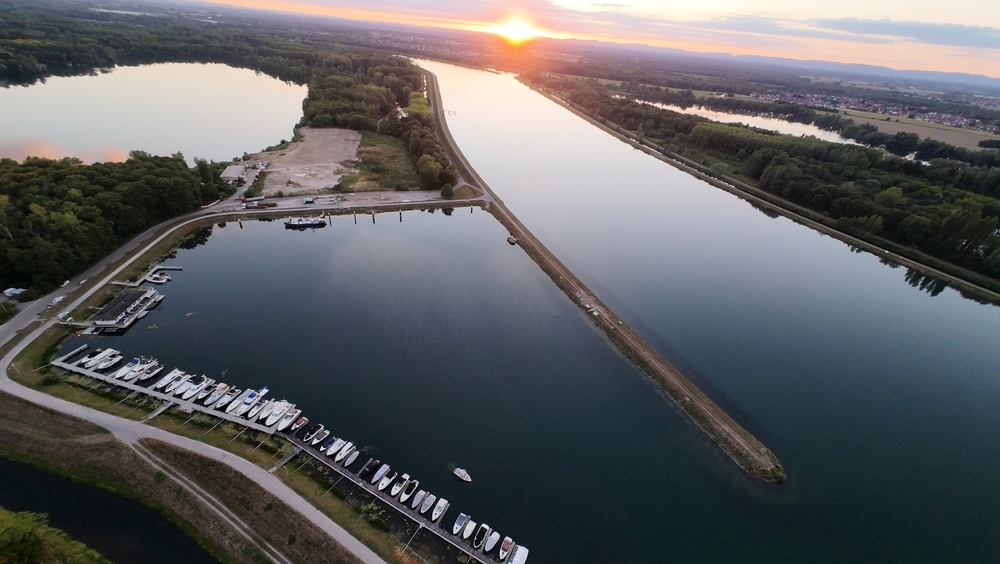
Day 4: Greffern to Altenheim with a stop in Strasbourg
To enter Strasbourg we had to go through a lock with barely any height difference. We found a vacant spot at the city harbor. Entering the canals would require a vignette. We walked instead, and disovered a very nice old town. In the evening, when we approached the north lock, one of the kids wanted something from the cabin, which I had locked prior to going to the city. So I landed the boat, retracted the foils, removed the ignition key to unlock the cabin. When I switched the boat back on, it somehow confused the foil position, because I switched it off, while the foil retraction was still in progress. The aft foil went all the way down, farther than usual. It seemed to be stuck there. I tried to pull it up with a rope and a lever, while initiating a retraction on the touch screen. Didn’t work, and like this the motor refused to start.
While I tried to fix it on anchor, a rowing boat approached. My wive screamed. He slowed down and still hit us. Fortunately, no damage.
I was still trying to retract the aft foil with the tools I had at my disposal, when my wive asked ChatGPT for help. It gave her some phone numbers. The Candela support hotline didn’t answer, so she called a German Candela dealer. They had direct phone numbers, and asked Candela employees to call us, presumably in their free time. One of them told me how to enter the service menu, and manually run the retraction motor little by little.
Before we could foil again, I had to dive under the boat, and remove the seaweed from the foils. I had to do this a couple of times actually on this trip. At home on the lake I never had that problem, as you are not even allowed to enter zones with water plants. But on the Rhine or the Strasbourg channels, sometimes you have no other choice. In the obscure water it is also difficult to see. And the foils collect whatever comes close.
Since we charged the boat during our stay in Strasbourg, we didn’t run the battery empty this day, but only drove to the marina in Althenheim. By the time we arrived it was dark, and I didn’t feel confident enough to navigate in unfamiliar territory in the dark.
Day 5: Altenheim to Breisach
When I asked the people in the boat just next to ours about what to do in the vincinity of the harbor, I learned that their boat was also electric. It was a steel houseboat that was converted after the engine needed replacement. Their boat has a max speed of 12 km/h and they cruse mainly around the French channels. So it is a completely different experience from ours.
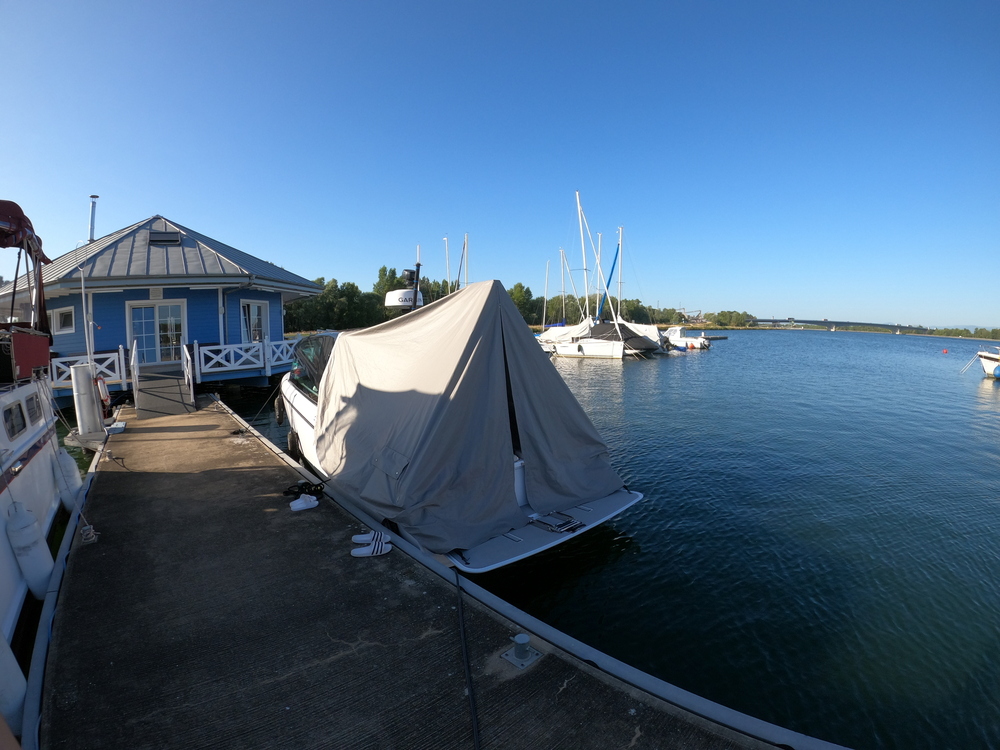
Today we saw a number of locks, but otherwise little civilization until we arrived in Breisach. On the way we entered a side arm of the old Rhine for some swimming. We did not know Breisach before, but many boaters along the trip told us they like to go there. With the big church and other buildings standing on a big rock, the landscape was truly different from what we saw in the flat lands so far. The Breisach harbor was full, so we went to the French side just opposite. Even if we didn’t have much of a choice, we didn’t anticipate the 3km walk to reach Breisach. Then again, after sitting on the boat, a walk was always welcome.
Day 6: Breisach to Kehl
The Candela trip computer calculated that with the fully charged battery we should arrive in Kehl with slightly less than 10%. It assumes two people without luggage, and most likely a boat without any options. The experience from the previous days told us that most likely it would not be enough. I hoped that the current, while barely noticeable, would help us. Instead we had strong headwind. In addition we had to stop a couple of times for the locks. Accelerating to get up on foils each time after the lock also cost some energy. When we arrived in Altenheim we decided to make a stop and recharge a bit while swimming in the nearby pond. Maybe it would have been quicker in the end to just drive very slowly instead of charging slowly and then foiling fast. I haven’t figured out all these calculations yet.
packing and going home
My wive made the appointment for putting the boat back on the trailer. In the morning we were ready earlier than anticipated. So we tried to do it ourselves. It took some trying, but we figured it out. When the harbor master arrived, he helped us secure everything for the trip back home.
recap
Now lets come back to my initial questions that I could not fully answer before the trip
- How would foiling work on a river with current?
Sometimes I get warnings on the screen about GPS accuracy being low, and that this could affect foiling performance. That made me thinking, that if GPS was the only velocity input to the flight computer, then a current could severely skew those calculations. So I contacted Candela support, asking how foiling would work on a river. They told me that it would feel awkward, but should still work. They also told me that the height sensors would be more important for take off than the GPS speed input. Turns out it was no problem downstream, but I needed a trick to get up on foils against a 12km/h current. I will report the exact timestamp to Candela support, so they can use the logged data to improve the software.
- How would the range be affected by the current?
This one is hard to answer. Since we had to change our plans due to the low water, we only spent a limited amount of time in the section with the fast current. But our range was lower than the range calculator on https://candela.com/leisure-boats/candela-c-8/ would suggest, even if I set it to 6 people. The reason is likely the many locks we had to go through, and the acceleration phase after each of them. I always tried to go with 22 knots relative to the water, and tried to minimize the kWh/NM reading on the screen. Typical values were between 1.5 and 1.8 kWh/NM, but sometimes it could go up to 2.0 for a short time.
One very useful value when driving in unknown territory is the projected state of charge upon arrival. In the Tesla this value is updated continuously, and you can juggle a bit with the speed, as in the car it is clearly correlated. With the Candela boat, 22kn is really the sweet spot. If you go a little bit slower, you actually consume more power per distance. If you want to consume less, you have to go a lot slower in displacement mode. But more importantly, the Candela trip computer shows that value only for a short time in a message box, after entering the destination. It would be really helpful to have this value continuously calculated as in the car. And it would also be helpful to base it on the current consumption.
One thing that is obvious however: Going against the current in planning or displacement mode eats the battery really fast.
- How would charging work?
This was more or less as expected. In my preparations I didn’t find a single fast charging station along the Rhine. I found some shipyards that could provide 11kW for emergency needs during business hours, but we ended up not needing this. All the harbors offered the standard blue one phase camping plug. It is supposed to deliver 3.6 kW, but the boat displayed charging speeds between 2.8 and 3.2 kW. This is mostly due to the voltage sometimes dropping below 200V at the berth, but also charging losses may contribute.
The usual “charging over the night is enough” from home didn’t fully work out. At home we rarely spend consecutive days fully on the water. Either we return with a battery that is not totally empty, we start later the following day, or we make a shorter trip the next day. So we had to juggle a bit with this on the trip, but it worked out quite well in the end. Being able to charge while visiting Strasbourg was a big bonus in that regard.
If you treat the “driving electric” as a given, and accept the current limitations of the infrastructure, you can adapt your plans accordingly. But if you expect the same overall behavior as filling a gas tank, then you might get disapointed, until there are fast charging stations. On the other hand, I saw many people carrying gas canisters, saying there were no fuel pumps in reachable distance. In the end everybody has to decide for themselves, which option is more convenient.
- How bad would the traffic be on Europes busiest inland waterway?
Due to the low water there was very little traffic. For the most part we were on our own. The big ships didn’t produce a huge wake neither, because they were loaded only 20% of the usual capacity. There was a single occasion where I went off the foils, because two big ships were crossing just in front, and I was not sure if there would be enough room. With the low traffic, AIS was definitely not needed. But the radar was of no use on the narrow river. Even at home, MARPA often has false positives on the shore. But on the river I could either zoom so close that it would be too late anyway, or have the screen full of false positives. Now I know why Swissradar do the processing with exact maps.
- Would my trip plan hold up, or would we have to improvise?
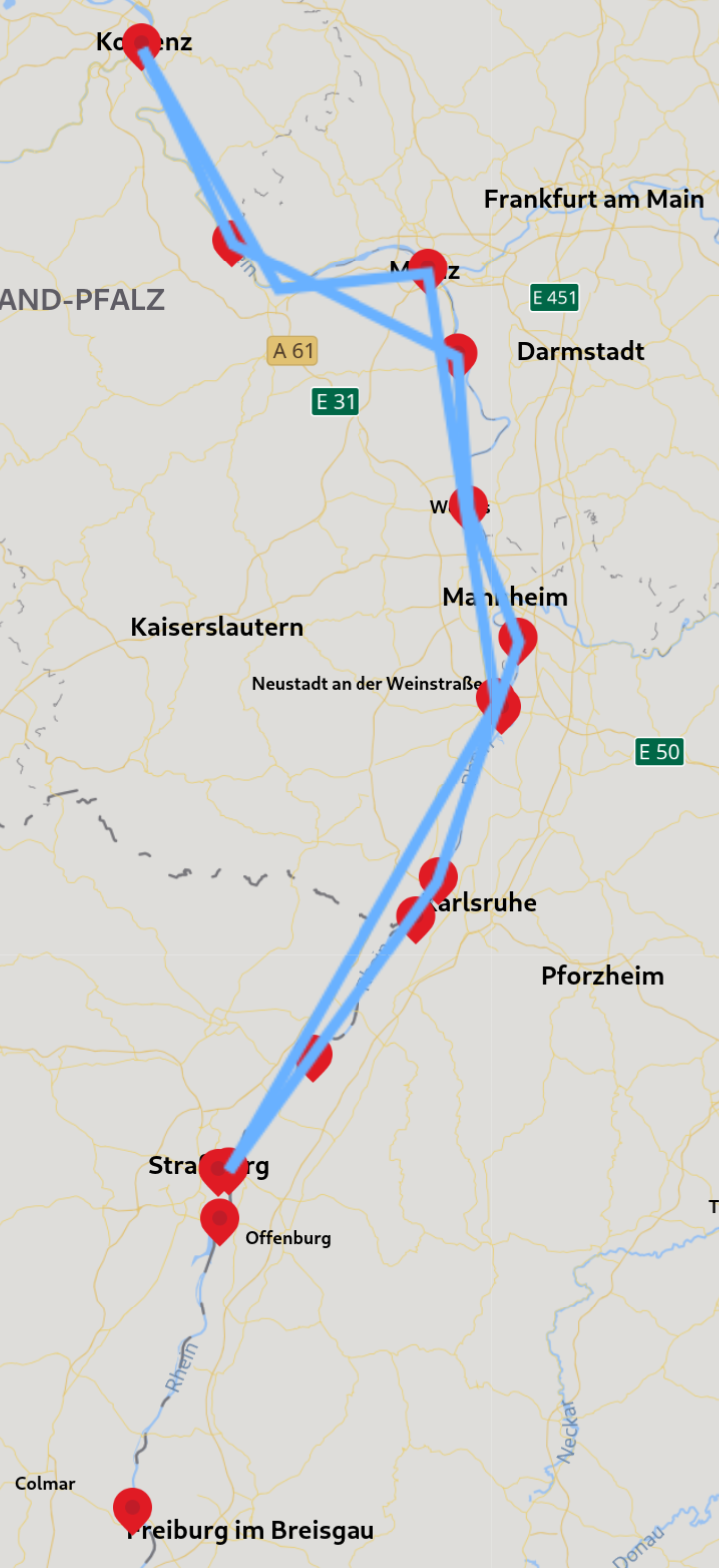
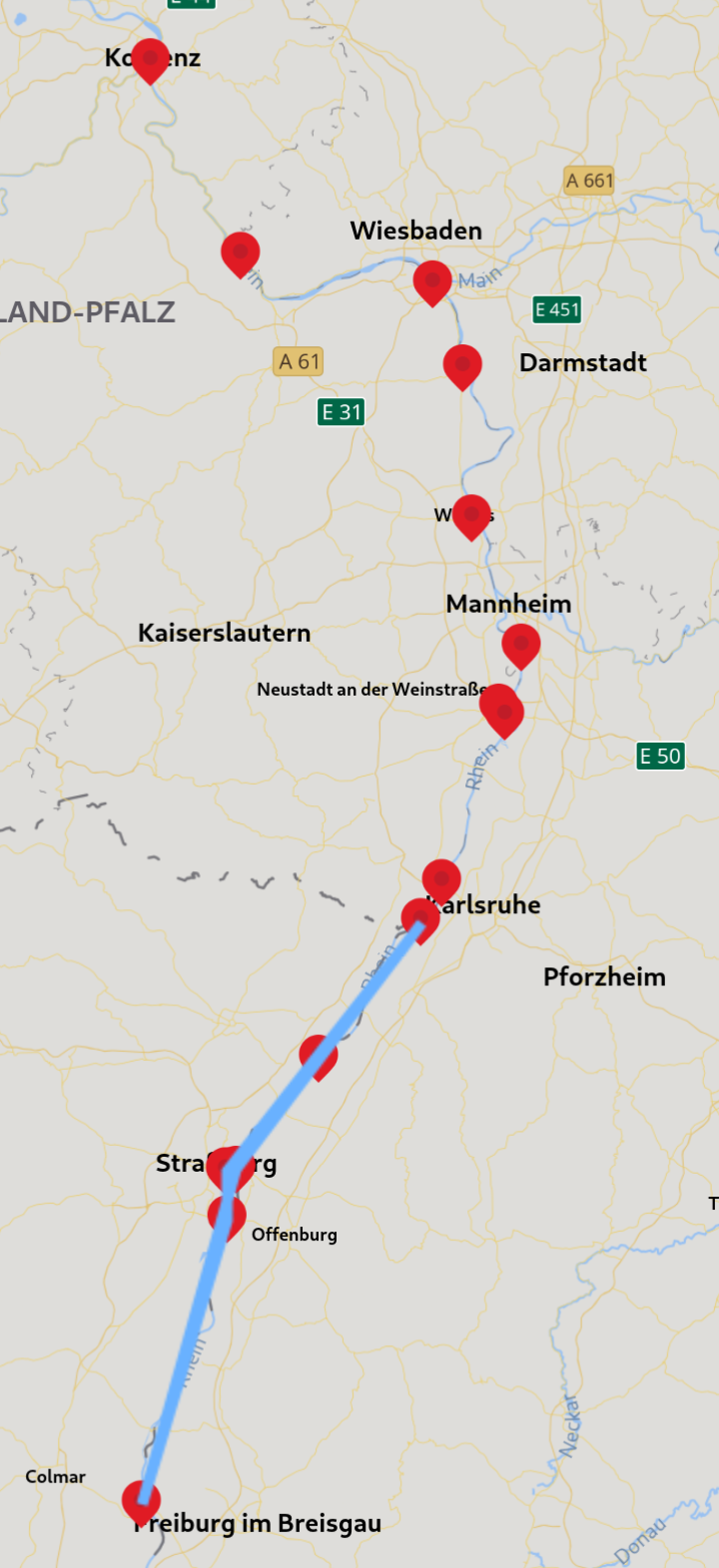
The initial plan was to go from Kehl to Koblenz and back. I was especially looking forward to the part around the famous Loreley. Due to the low water, our trip ended up completely different than planned. From what I heard beforehand, the lower part would be more interesting and beautiful, with many interesting cities right at the river. Even though the upper part is an artificial channel, the environment is mostly wilderness. There are plenty of small harbors along the way, that have toilets, showers and electricity. But you are lucky if there is a restaurant or a shop or even a village nearby in walking distance.
- How would trailering the boat work?
I am really glad, Ernesto from UniNautik, who rented me the trailer, showed me how it is done properly. I thought no harbor crane would be available on a Sunday, and I wanted to see and know how trailering works. With our trailering attempts, the freshly applied underwater antifouling paint got damaged a bit, and needed some rework.
Now that I did it with instruction and on our own, I would try to use a crane next time. Driving with the trailer was totally fine, even backwards around a corner down the slipping ramp.
- How would the family like it?
Ever since I ordered the boat, occasionally I watch youtube videos of people living on their boat, while doing great adventure trips. I got hooked to the point that I could imagine taking some months off after the kids finish their education. On our great South America adventure we often met people in their fifties. The rest of the family is not so much into such stuff. The boat was not really designed for multi day family trips like this. It was marketed for weekends and the cabin is for two adults plus two small children. Our boys are taller than us by now. Knowing this, I had the harbor cover made with a zipper, so that the aft part can be used like a tent covering the aft sun lounge. We slept like this on the boat before. I usually sleep well, but the rest of the family prefers a proper bed. I am also the only one who was in the army and in boy scout camps. What was new on this trip was the amount of luggage. It got very crowded. Like in the old days with our small camper van we had to juggle the luggage around between sleeping and driving. Sadly, now we are a bit divided. I enjoyed a trip like this very much, and would like more of that. The rest of the family complained a lot, and had enough for a while. They still enjoy the day trips, just without spending the night on the boat. This is something I often hear from boating families. It seems to be only in the youtube videos that everybody involved loves to sleep on the boat.
Planned vs actual route