Every year in late August there is the night regatta on Lake Lucerne. I learned about it only last year, and went to observe the start as well as a small part in the dark. There was very little wind, so the boats moved super slowly. Nonetheless the scene was impressive. I was floating in the middle of the lake as ten sailboats with dimly illuminated sails passed.
This year I was asked, if I would host the security chief on my boat while accompanying the regatta. That’s such a cool event that I agreed Being awake the whole night is not so easy any more in my age. And it kind of excluded the weekend for other family adventures. But my main concern was wether the battery would last. If I drove the course of the event all at once on foils, it would consume roughly half of the battery. But I didn’t know how much I would have to go back and forth, and at what speed. My boat consumes about the same amount of energy per distance at 40 km/h on foils as well as at 10 km/h in displacement mode. If I go slower than 10 km/h I can go signifficantly farther, but I didn’t extensively test this so far. But any speed between 10 km/h and foiling burns considerably more energy, and thus reduces range. So If there was good wind, and the participants could sail with 20 km/h, I might need a good strategy. Because if I go for some distance and sit for a while, every acceleration to get up on foils again also costs some energy.
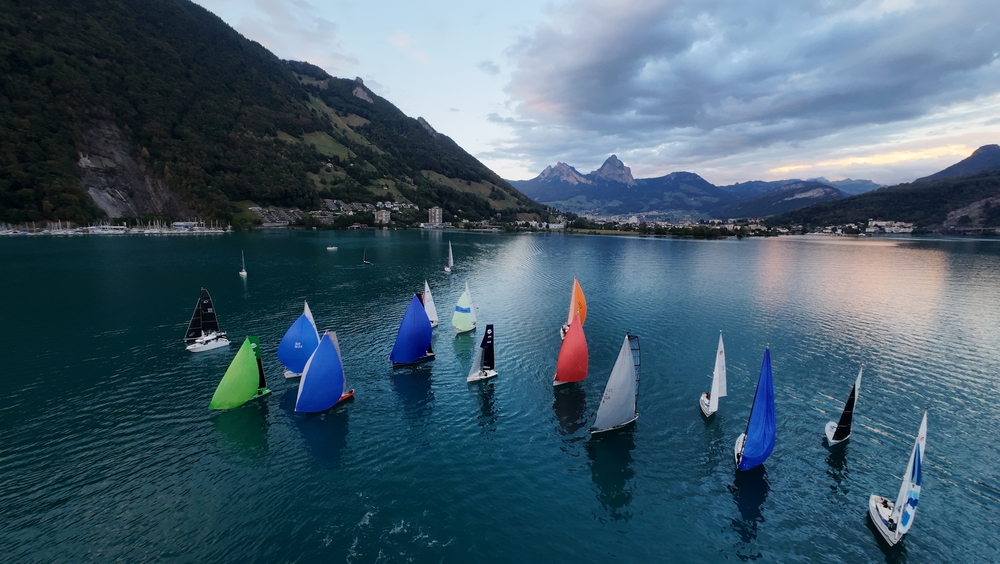
At the start the wind was barely noticeable, and so the boats moved slowly. It was interesting to see the difference between the different boats. Even more interesting to see was how the wind flowing down some mountain slopes gave an advantage to the sailors who were close to the shore below those mountains. As the lake has a very interesting topology, the conditions were very interesting to observe. Sometimes there could be opposite wind directions within less than 5 km. And in between there were areas with barely any wind. Sailing regattas really has lots in common with cross country paragliding.
I tried to preserve energy from the start, and drove at 7 km/h most of the time. As far as I saw, none of the slower boats went faster than 10 km/h. Hence we often paused and waited for the trailing ones to catch up. To further preserve energy, we didn’t go all the way to the turning point. The boat also consumes some energy while the ignition is turned on for the computers and lights and radar. That shouldn’t be much, but that was also outside of my experience., The whole event could last for more than 14 hours. I never drove the boat this long in one go. There were a couple of motor boats with the organizers accompanying the saylors. Our position was always towards the tail end of the field. The slower category didn’t have to go all the way back to the starting point. So in the dusk, we waited for the last boat to appear at the finish line. When our job was done, the battery had still plenty to offer, so we foiled back home.
Guess how much energy was still in the battery when I plugged the boat in at the home berth? A staggering 67%. Apparently all my worries were unfunded.
You can replay the live tracking at Metasail My boat is labeled as SIBE